


Poke around the larger Anglican world with the question, "What do you think about the Continuum?" If someone has heard of it, common responses usually contain phrases like "immediately fell apart," "always splintering," and the usual "alphabet soup."
A brief overview of the history since the Congress of St. Louis seems to confirm this. There are now four major jurisdictions that directly descend from the original Anglican Church in North America: the Anglican Catholic Church, the Traditional Anglican Church, the Anglican Province of Christ the King, and the United Episcopal Church of North America. There is also the Anglican Province of America, formed from the American Episcopal Church and the Traditional Anglican Church. Additionally, there are smaller groups that have split off over the years, such as the Holy Catholic Church—Anglican Rite.
Scratch the surface of this history, and you will find that each of these re-formations contains an idea that, upon further inspection, may or may not appear consequential. The Diocese of Christ the King reportedly left first because Bishop Morse believed the proposed canons limited the role of bishops too much. A few years later, the Diocese of the Southwest, along with some Virginia parishes, left because they believed the canons granted too much power to bishops. However, they did not follow their previous bishop, Bp. Doren, into the UECNA and eventually became defunct. Despite the fact that Archbishop Falk enacted the constitution and canons that were the stated impetus for that schism, the system of governance in those canons—based on dioceses in regional provinces—was overthrown a few years later to create national churches. Thus, the Traditional Anglican Communion was formed. Churchmanship was the stated reason for the departures of the UECNA and the HCC-AR, which were on opposite sides.
A common thread in these splits, as well as the numerous smaller ones, is the desire for something better that promises to solve all problems and ensure success. This desire can manifest as either an act of contraction, reducing churchmanship or theology to narrow parameters, or an act of expansion, broadening liturgical practices and flattening matters of jurisdiction and governance. A full statistical analysis of this history has yet to be conducted, but an overview reveals that, with each new realignment or jurisdiction, the total number of parishes and congregants decreased.
Some twenty years ago, Archbishop Haverland attempted to reunite the churches with direct succession to the Denver consecrations. He entered into intercommunion agreements with the UECNA and the APCK, intending to form full organic unity. However, that intention was not reciprocated, and the three jurisdictions remained independent. Although this effort stalled, the idea persisted. Beginning in 2015, a new alliance formed and resulted in the 2017 Atlanta Concordat, which pledged to "pursue full, institutional, and organic union." This time, the goal began to become a reality, with real mergers and agreements being made.
Merging multiple jurisdictions with overlapping dioceses, various bishops, and parishes that split from each other long ago was always going to be difficult. Various proposals were made and discarded when they were found to be unworkable. The idea of putting new episcopal consecrations on hiatus proved impractical. The ACC canon demanding geographic dioceses was ignored for the Diocese of the Holy Cross. However, there's no getting around the fact that G3 could also stand for "Three Georgia Bishops."
Nevertheless, there was persistence, and efforts toward institutional unity proceeded. Institutional unity means having one set of governance structures, which requires agreement on one Constitution and one set of Canons. The ACC has continued to use the canons established in Dallas in 1978, with modifications and changes made over the years. Other churches have formed their own canons based on their own ideas and ecclesial commitments in policies and procedures. However, the common basis for unity, as stated in the Concordat, is the Affirmation of St. Louis and “in the faith of the Holy Tradition of the undivided Catholic Church and of the seven Ecumenical Councils.”
In 2022, Bishop Robert Giffin of the Diocese of the Central and Western United States posted in the AJS Facebook group that he would dissolve his diocese and become an auxiliary bishop for the sake of AJS unity. The post was quickly deleted. At the time, liquidating dioceses and placing parishes into different ones was a touchy subject, and "demoting" bishops wasn't up for discussion. Additionally, his diocese was one of two in the Anglican Province of America, so dissolving it would mean transferring its parishes to other churches. No matter how well-intentioned the idea was, it threatened to impede the discussions for unity.
Since then, Bishop Giffin has publicly and privately expressed a growing distaste for other parts of the AJS. A parish in his diocese, having not received a visit from Bishop Giffin for many years as required by the canons, transferred to the ACC. He complained that he wasn’t invited to a missions conference. Then, Fr. Calvin Robinson was disciplined by the ACC.
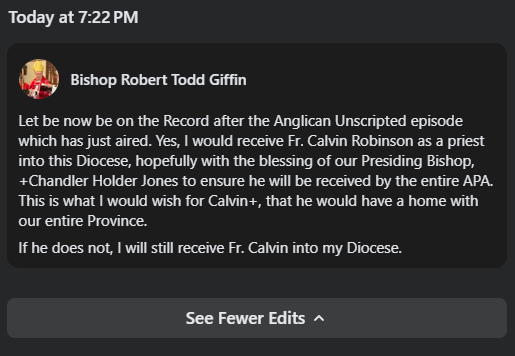
At first, the fallout from that last event was quiet, but it is clear that Bishop Giffin was already contemplating disassociating from the AJS. He refused to participate in creating the AJS Annual, thus preventing his parishes from being listed in the compendium of member parishes. Shortly after Calvin Robinson was deposed from the ACC at the end of May, Bp. Giffin posted about his desire to receive Robinson in the APA.
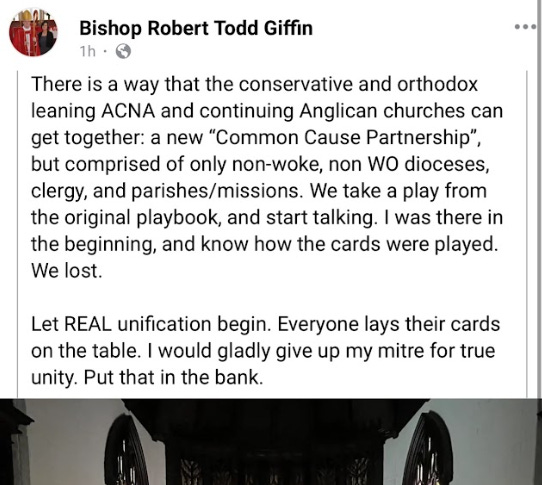
On June 1, Bishop Giffin suggested forming a new "Common Cause Partnership" and said he would give up his mitre for "true unity."
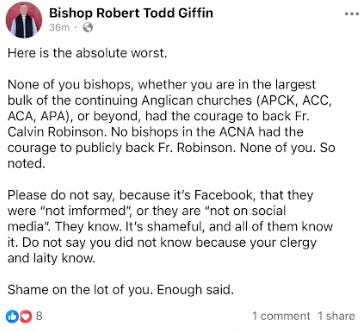
There was no public movement following that, and on June 13, Bp. Giffin made a post complaining about the lack of support.
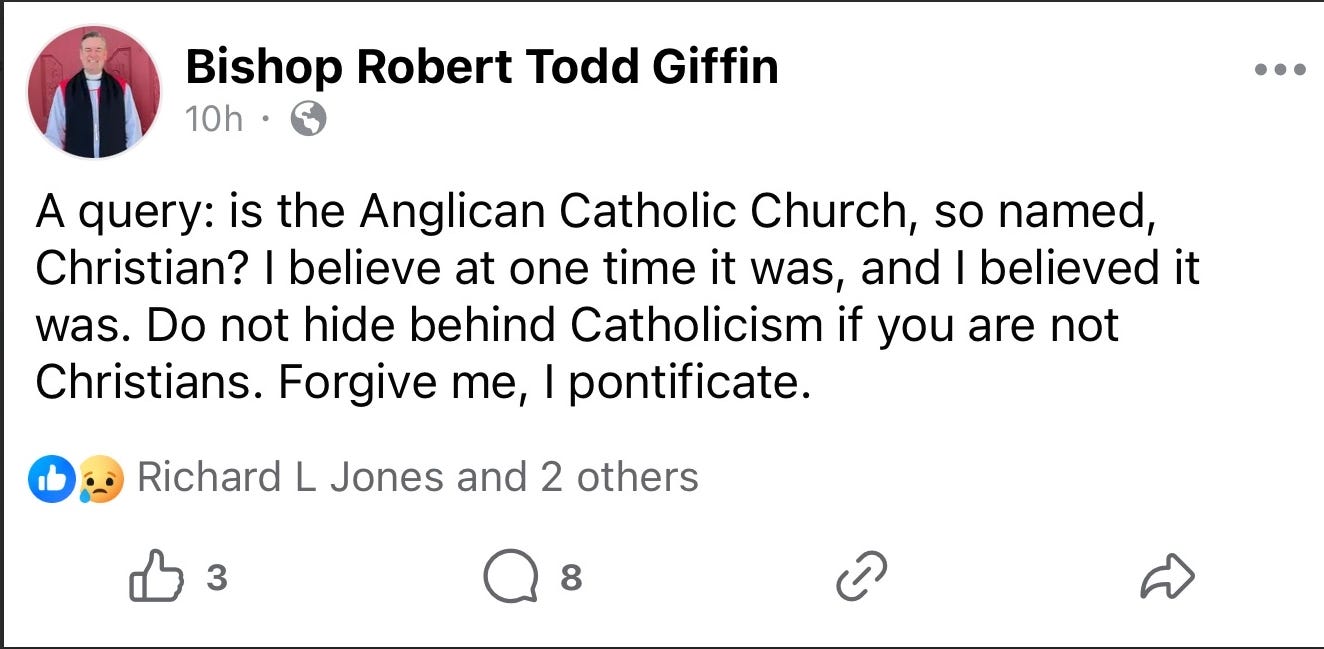
On June 26, he made a post asking if the ACC was Christian.
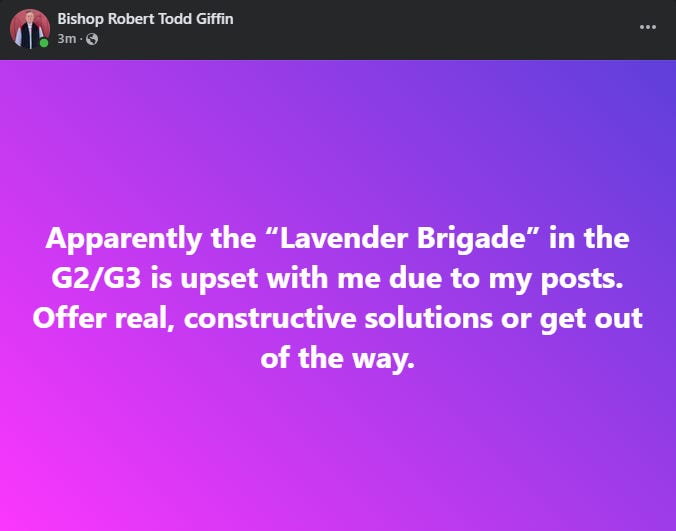
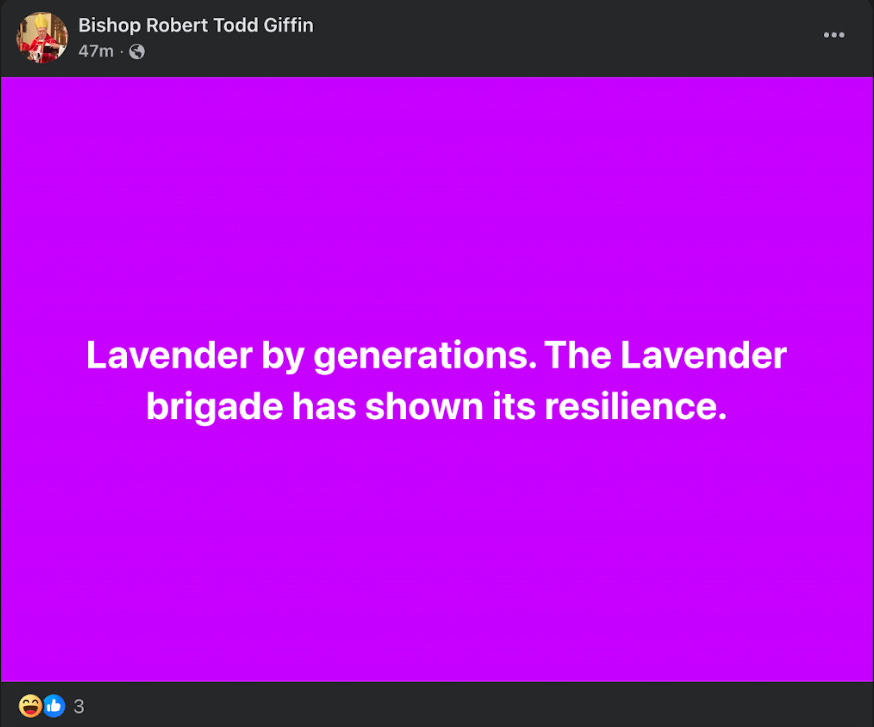
On June 30, he called those upset with his posts the “Lavender Brigade.”
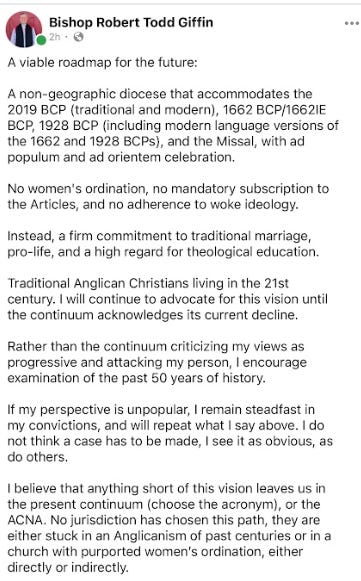
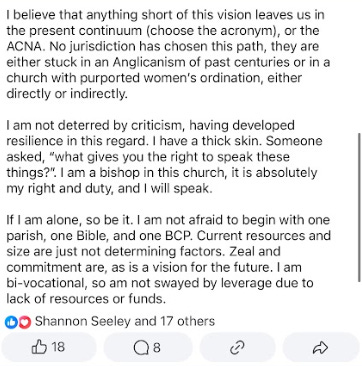
This escalated throughout July, with a “roadmap” for a non-geographical diocese which isn’t a part of ACNA or any continuing jurisdiction posted on July 5.
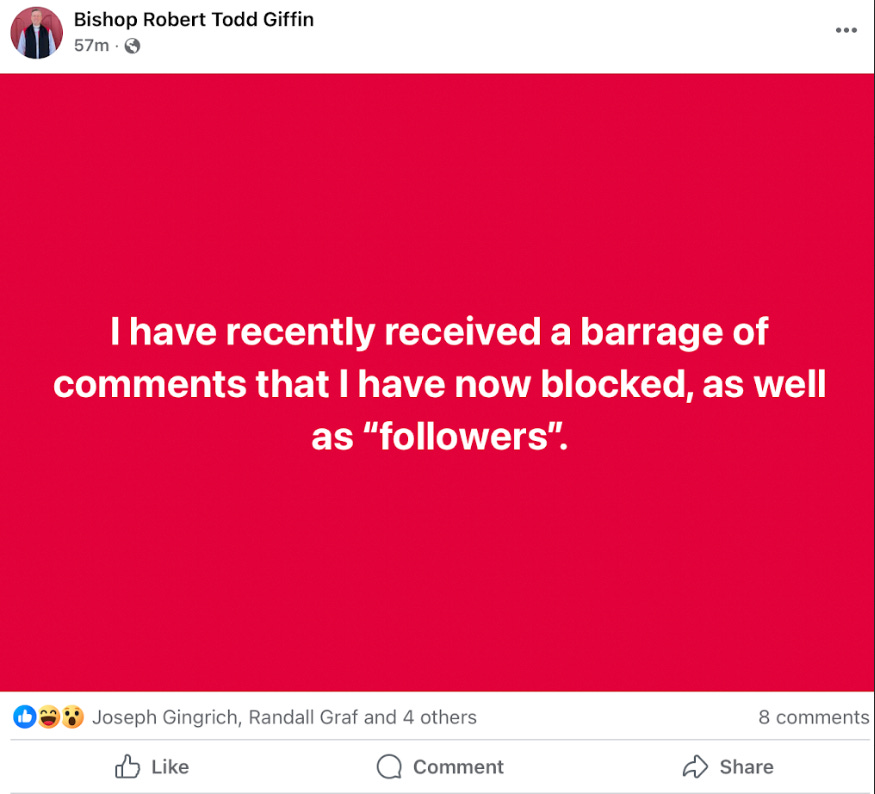
He also posted on July 5 that he had blocked a number of comments.
On July 11 he posted that he believed that the “continuing Anglican churches” were being led astray.
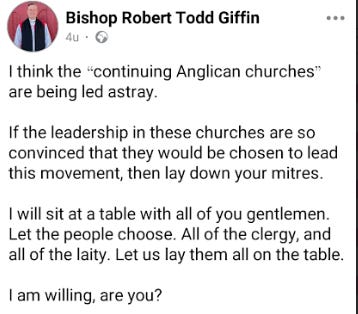
When people pointed out that all the bishops had already been elected by the clergy and laity, their comments were deleted and they were blocked.
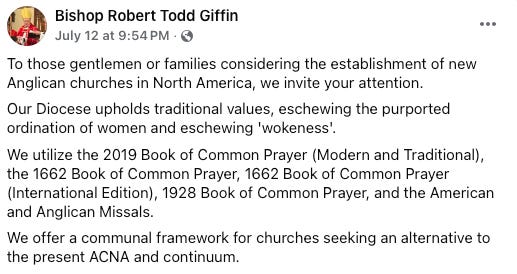
On July 12, he posted again, this time describing his diocese as an alternative jurisdiction for churches in ACNA or the Continuum.
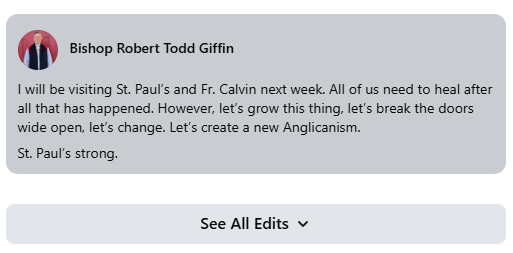
He then announced that he would be visiting Robinson’s parish.
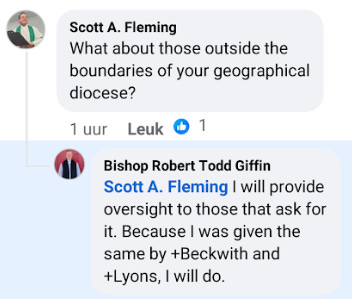
When asked about his geographical jurisdiction, Bp. Giffin indicated that he would provide oversight outside of his canonical territory.
July 21, Bp. Giffin posted that neither ACNA nor the Continuum knew the future of Anglicanism in North America, which he said would be “broad-minded” to include “Anglocatholic, Evangelical, and Charismatic.”
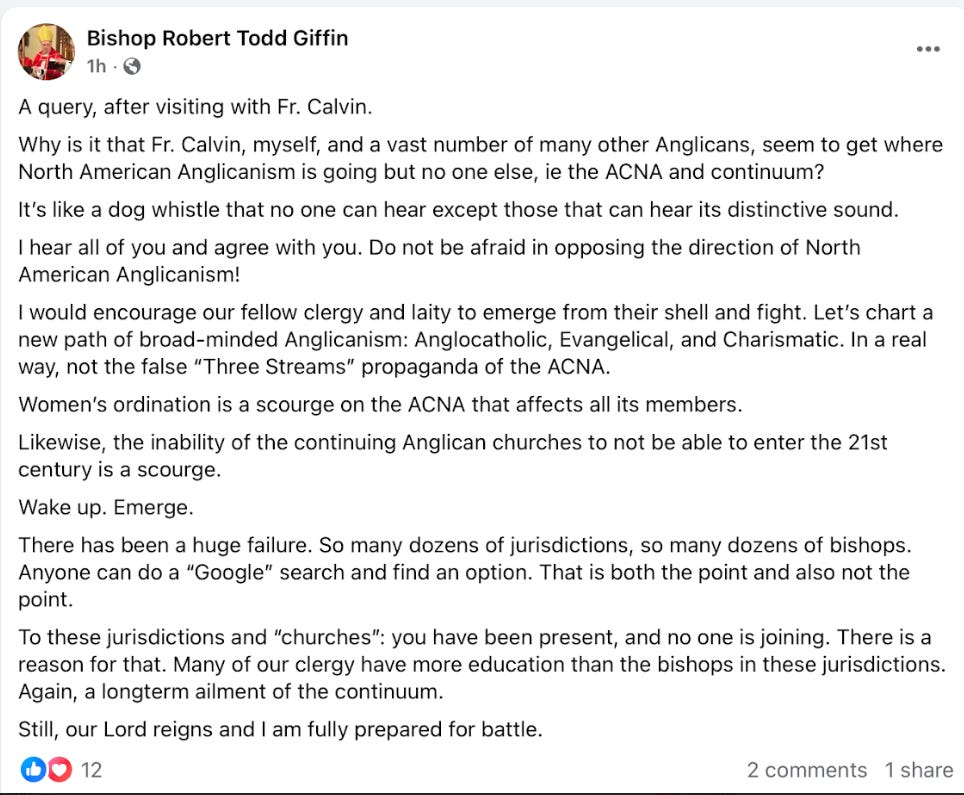
Also on July 21, Bp. Giffin posted to encourage people to “vote with your feet.”

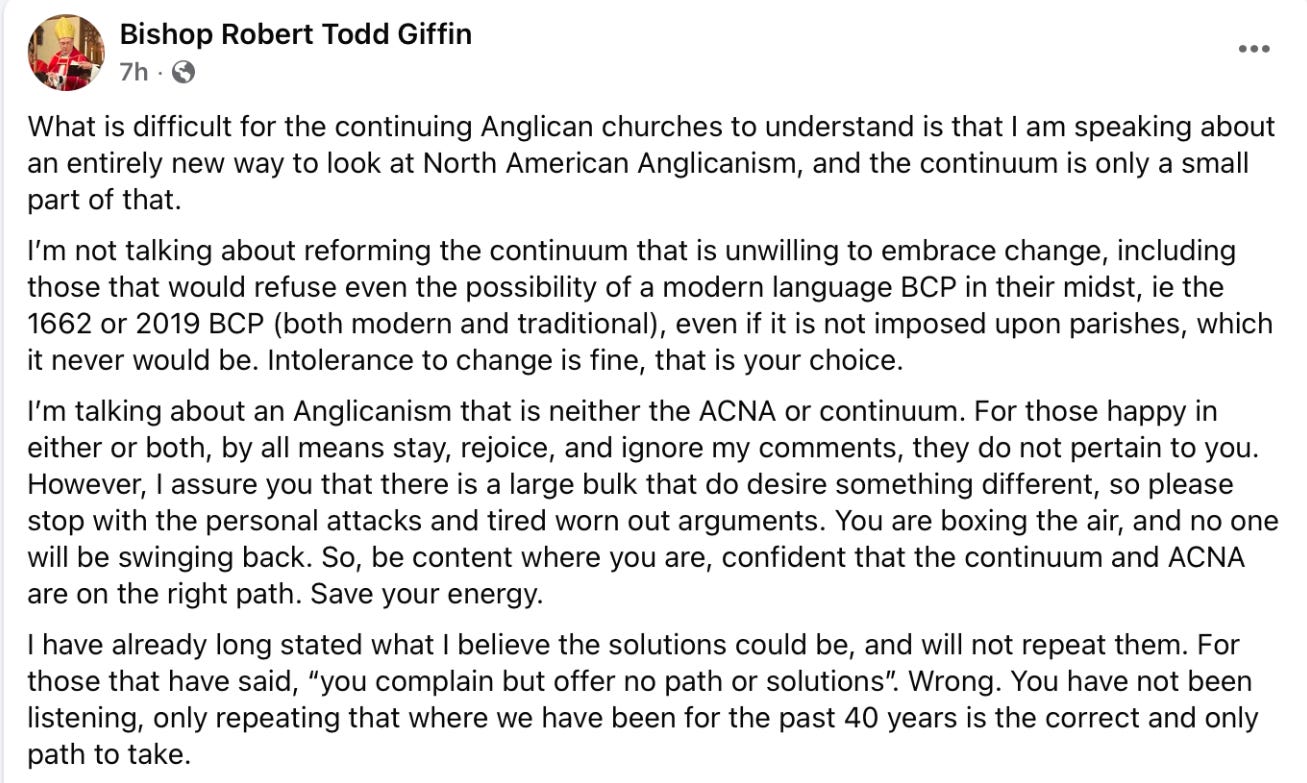
On July 23, he again stated his desire to form a new Anglicanism which was neither ACNA nor in the Continuum.
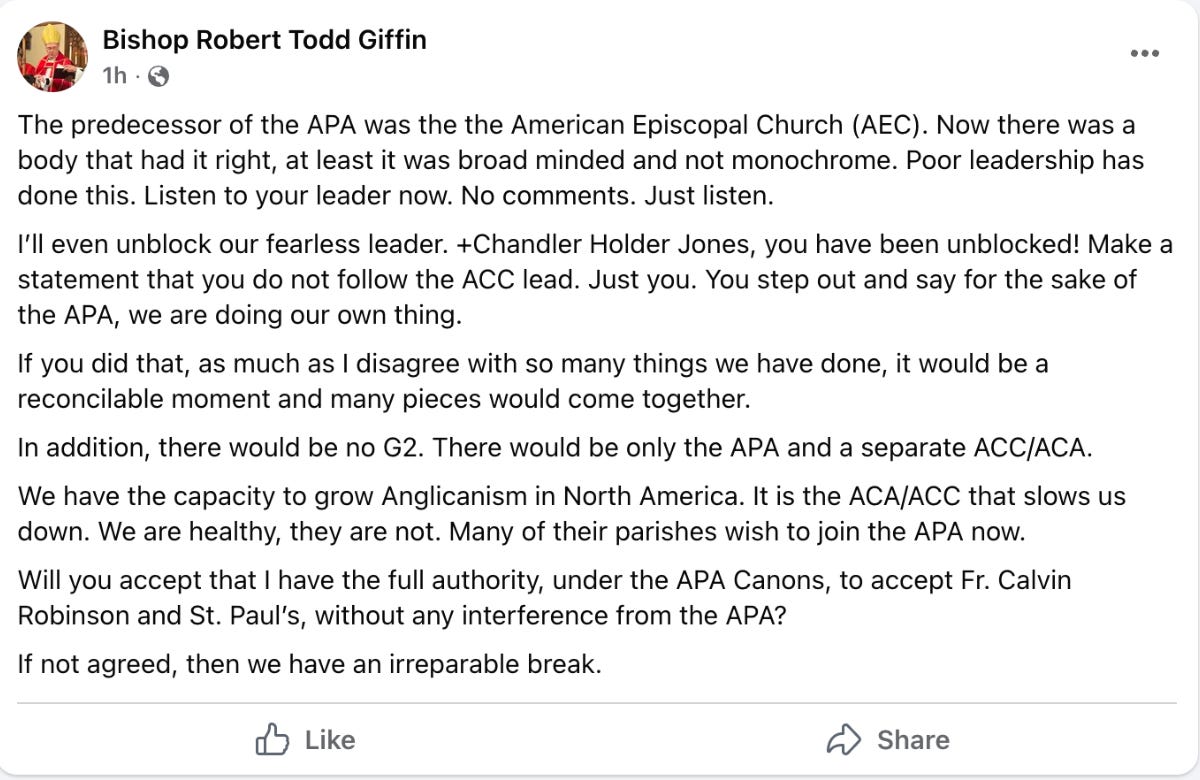
On July 27, he stated that he wished for the APA to withdraw from the AJS, and that if he could not accept Robinson and his parish, there would be an “irreparable break.”
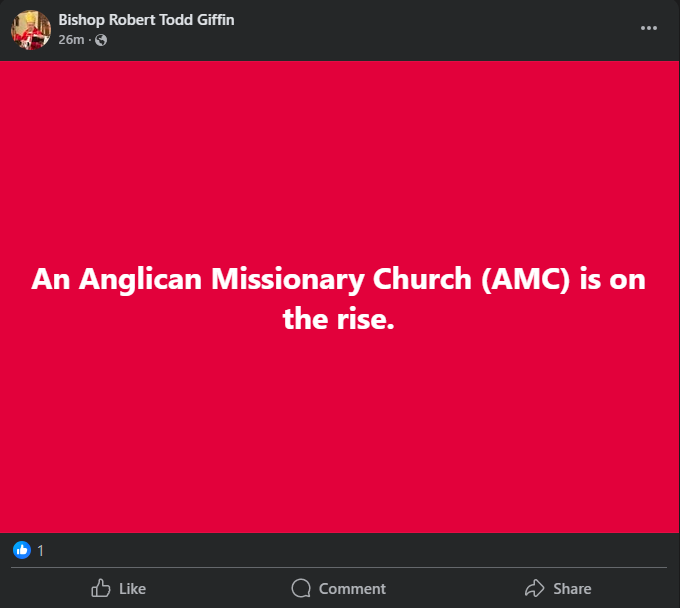
On July 30, Bp. Giffin posted “An Anglican Missionary Church (AMC) is on the rise.”
On August 1, Bp. Giffin posted Abp. Jones’s letter of inhibition, and stated that he was still the bishop of the diocese.
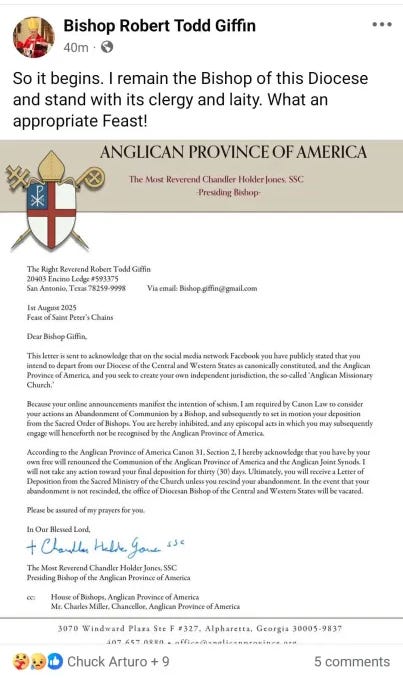
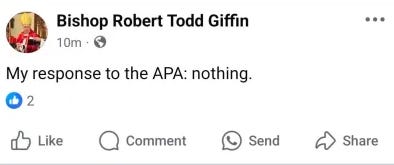
He initially stated that he would not respond to the letter from Abp. Jones.
He then made a post calling out a “lavender brigade.”
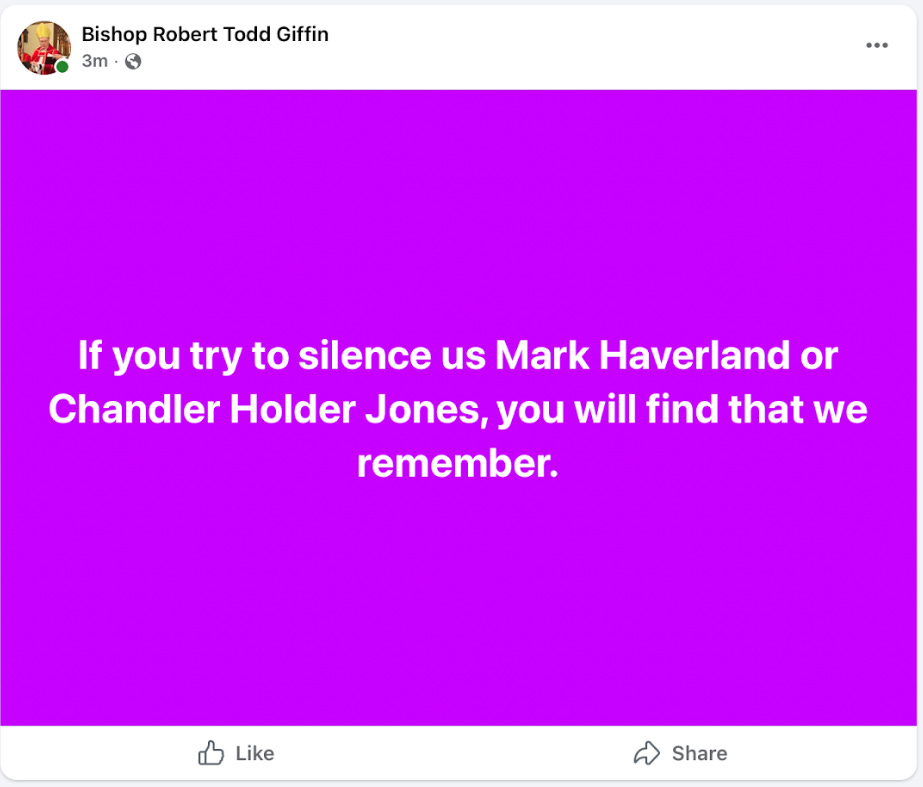
He then made a post naming Abp. Haverland and Abp. Jones.
The following post indicated that he intended legal action.
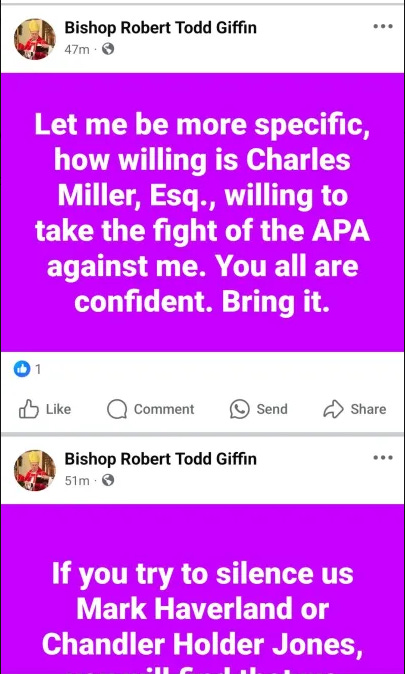
On August 1, he also removed his affiliation with the APA from his Facebook bio.
On August 3, Bp. Giffin announced on Facebook that his diocese had disaffiliated from the APA.
He followed up by posting again that he intended to leave ACNA and the Continuum.
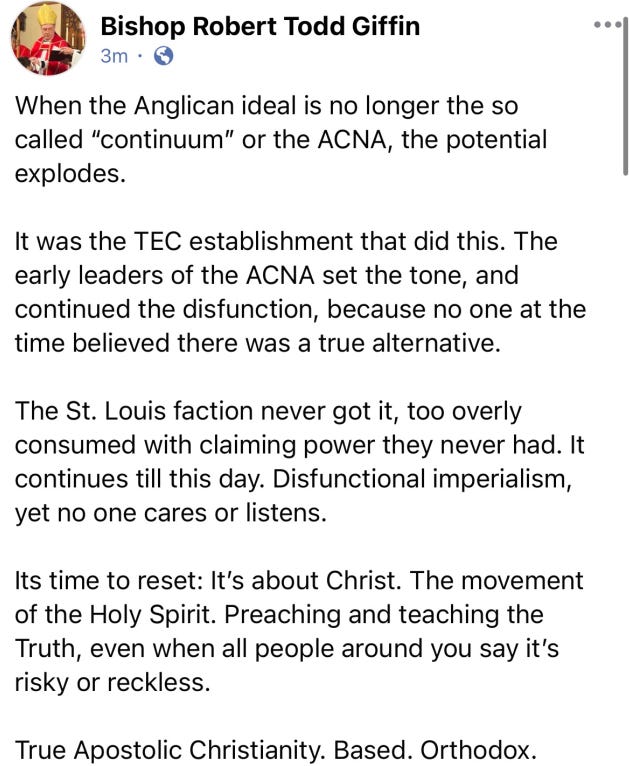
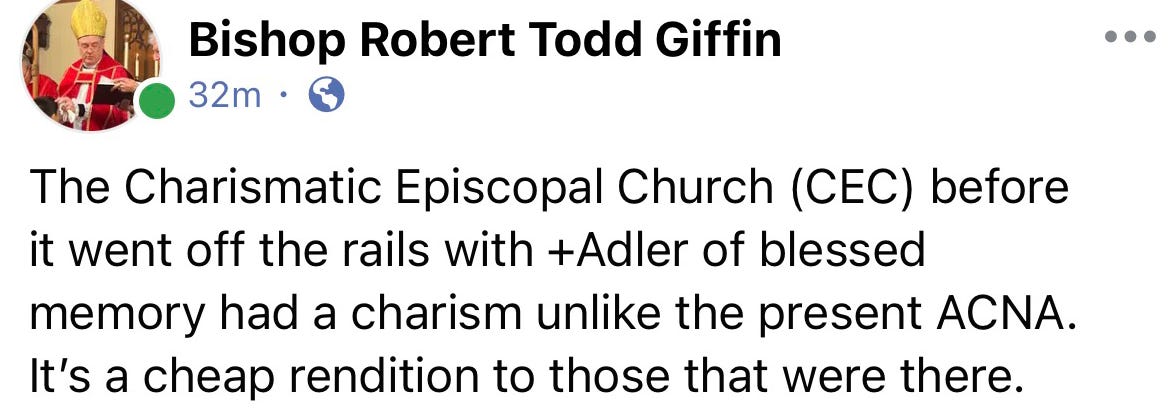
He then mentioned the Charismatic Episcopal Church as the ideal.
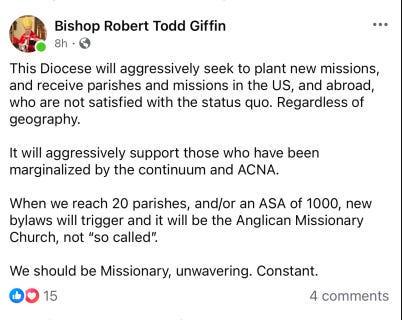
He then posted his goal of establishing the Anglican Missionary Church.
Throughout this period, Bishop Giffin has frequently referenced his time in the pre-ACNA alternative oversight jurisdictions. While the full history before his consecration as a bishop in 2012 is unclear, it is known that Giffin attended Nashotah House as a seminarian for the Diocese of Quincy. He then served in the Dioceses of Springfield and Bolivia and CANA before joining the Anglican Church in America for a few months. He subsequently took his parish to join the Antiochian Western Rite Vicariate and ultimately ended up in the APA. He used different prayer books and rubrics in each instance. Therefore, it is no surprise that Bp. Giffin is allowing nearly every prayer book and churchmanship in his new jurisdiction; he has experience with nearly all of them.
Bishop Giffin has repeatedly used the word "broad" to describe the goals of his church. This is evident in his decision to place almost no limits on which prayer book, alternate service book, or missal members can use and in his refusal to require members to subscribe to the Thirty-Nine Articles. However, he has also shown a desire to limit the scope of his church. For example, he has expressed reluctance to join ACNA due to some dioceses allowing female priests while reaffirming intercommunion with the REC. He insists on apostolic succession based on unspecified parameters and advocates that clergy be allowed to be politically partisan as long as they support Trump and not "liberals." Additionally, he says his church is to be "anti-woke," a term left undefined. By defining his ideal church in such a narrow way, one wonders how much deviation from these vague parameters he will actually allow.
Sometimes, returning to the past is an act of devolution. The Common Cause Partnership was chaotic and unable to provide long-term stability. This is why it eventually gave way to ACNA. Attempting to return to a certain point in a movement and remain there is fighting an already-found conclusion. Returning with the hope of forcing a different conclusion, one that you prefer better, is idiopathic folly.
There is no going back; only going forward. This was also true in St. Louis, which built upon decades of momentum given voice in organizations like the American Church Union and the Fellowship of Concerned Churchmen. Whether we are aware of it or not, and regardless of our feelings, we are part of that rushing current. We can steer, row, and hoist the sails. However, if you want to be in a different stream, kicking and screaming won't get you there faster. Trying to change the stream you’re in is delusional. And trying to make the stream you’re in a different stream alltogether is delusional.
Unfortunately, some people have left because they no longer want to be part of what we agreed upon in 2017. However, as the above history shows, it is inaccurate to characterize Bishop Giffin as having been "pushed out." He decided he wanted to pursue a different path, one that was in opposition to our vision. Nevertheless, we are moving forward together, finding unity in our shared identity. This is not easy, and probably not everyone will get everything they want, but grace and magnanimity make our witness stronger.
Reading his various posts and comments, I feel that I am witnessing a mental breakdown. In place of faith and orthodoxy, he would impose political ideology, which is an idolatrous form of sinful loyalty. It seems that the church he wants to rule over would be just as bad as the Episcopal Church has become, that is, committed to being on one of the two wings of political partisan idolatry: They’re on the extreme left, he is on the extreme right, but it is two wings of the same dragon, as I have been saying for the better part of 30 years. And then he accuses everybody who disagrees with him, at least by implication, of being a homosexual. At least that’s how I read his use of the word “lavender.” It’s an old trick. The Soviet officials always used it against anyone who opposed communism, that is to say their power.
He’s obviously paranoid.
- Fr. Hart
What confuses me is what he is (not) saying ++Jones has done. If it is so objectionable and wrong please give us the details to evaluate for ourselves. I would like to know what it is that is going on with the merger which causes people such distress.